

How To Set Up Folders On Android Phone
Android file management: An piece of cake-to-follow guide
From managing files on your telephone to seamlessly syncing folders with your computer, this guide will turn you lot into a certified Android file primary.
 By
By
Contributing Editor, Computerworld |

- Managing files on your Android phone
- Supplementing your phone's local storage
- Transferring files between your phone and computer
- Transferring files wirelessly between devices
- Syncing your Android phone'due south storage with a computer
Show More than
When you recollect about your smartphone, apps and interfaces are probably the kickoff things that come to listen. Beneath all that surface-level stuff, though, our modern mobile devices are filled with files — folders upon folders of 'em! — but similar the clunky ol' computers we've relied upon for ages.
We may not come face to face with our phones' file systems too often, but information technology's valuable to know they're there — and to know how they can work for us when the need arises. Later on all, your Android device is a productivity powerhouse. Information technology tin juggle everything from PDFs and PSDs to presentations and podcasts. Information technology tin even act as a portable hard drive and house whatever sort of important files you might demand in your pocket (and not just on some far-abroad cloud). Your mobile device can acquit an awful lot of data, and there may come a time when yous want to dig in and deal directly with it.
Here's everything y'all need to know to go nether the hood and tap into your phone'due south file managing powers.
Managing files on your Android telephone
You lot might not realize information technology at a glance, merely Android actually allows you to access a device's unabridged file organisation — even from the device itself.
The operating system has had its own native file managing director since 2015'southward Android vi.0 Marshmallow release, and what started out every bit an experimental-seeming effort has evolved into a capable tool for basic information manipulation. With Android 6.0 through 7.1, the system-level file manager is somewhat hidden: Yous have to wait in the Storage section of your system settings, and then curl all the fashion to the bottom and tap the line labeled "Explore" to find information technology.
With Google's Android viii.0 Oreo release, meanwhile, the file manager lives in Android's Downloads app. All you have to practise is open that app and select the "Show internal storage" option in its menu to browse through your phone's full internal storage. You can and so open, move, rename, copy, delete, and share files as needed.
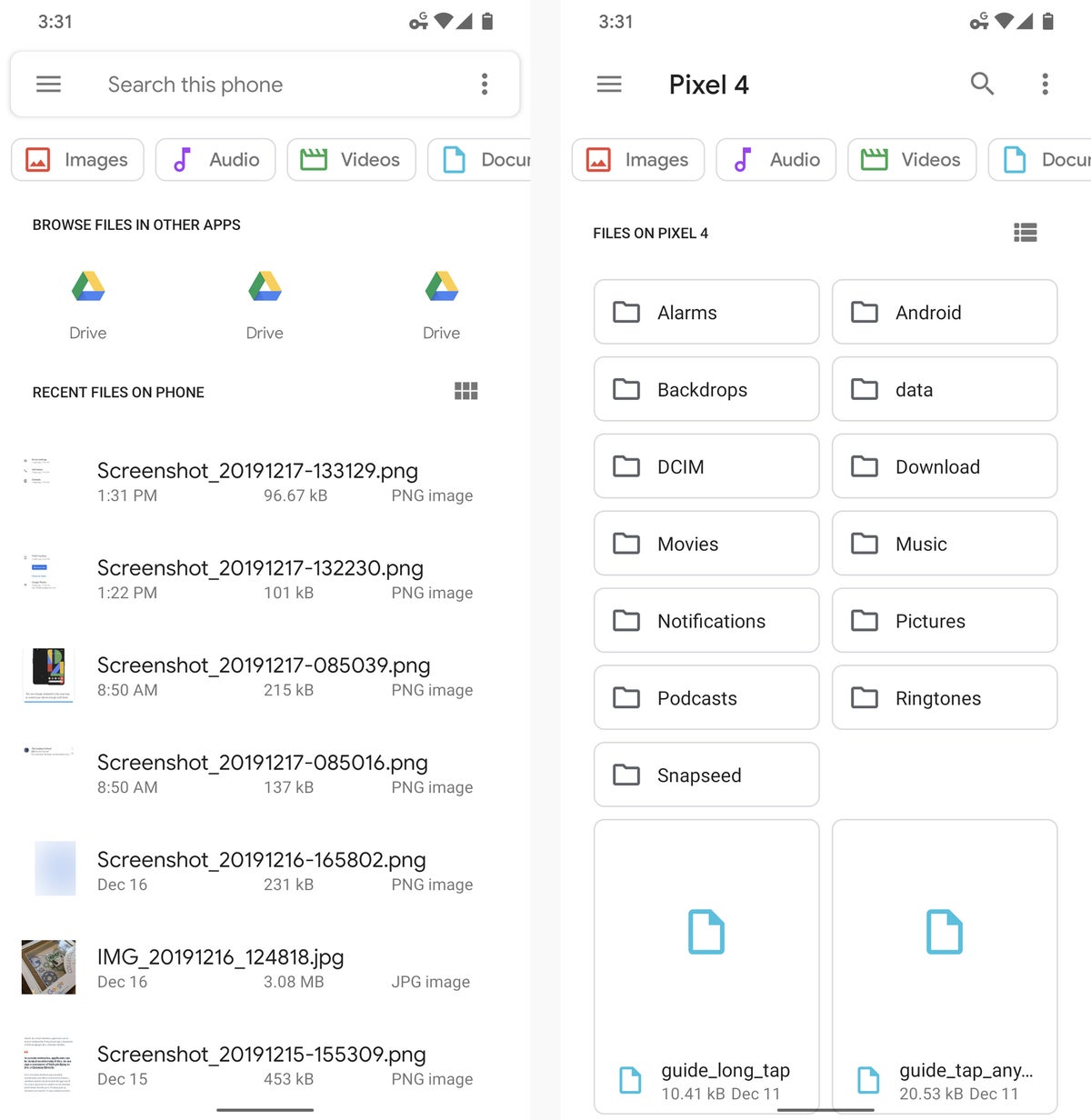
And if you have Android 9 or higher on your phone, things get even easier: In those contempo Android versions, the file manager exists in its ain sensibly named Files app. But open it up to scan any area of your local storage or a continued Bulldoze account; y'all can either use the file type icons at the top of the screen or, if you desire to look folder by folder, tap the iii-dot menu icon in the upper-right corner and select "Show internal storage" — so tap the three-line menu icon in the upper-left corner and look for your phone's name.
 JR Raphael/IDG
 The about recent version of the system-level Files app lets you scan through files in a diversity of ways, including via a traditional folder-by-folder view.
If you don't run across the Files app on your phone, odds are you're using a device by a manufacturer — such every bit Samsung — that opts not to include this system-level Android element in its software and instead to provide its own cocky-fabricated alternative (ostensibly with the goal of pushing its own cloud storage service and/or a paid partner's cloud storage service alongside Google Drive). Such an app might exist within a folder bearing the manufacturer'due south name, in your app drawer, and might be called My Files — or something along those lines. You'll probably find the same basic sort of file direction functionality inside information technology, just with a somewhat dissimilar interface and ready of options.
If you want to practise more than the well-nigh basic on-device file management, meanwhile, a third-political party file manager is the way to go. Yous tin find my latest recommendations for diverse needs in my separate roundup of the all-time Android file manager apps.
Supplementing your phone'due south local storage
One piddling-known feature of Android is its ability to connect with external storage devices similar USB memory sticks and even larger-chapters portable difficult drives. A phone but has to support something known as USB On-The-Get, or USB OTG, in lodge for the connection to work.
A fair number of devices, including Google'southward Pixel phones and many Samsung Galaxy products, offering such back up. If you aren't sure if your phone does, your best bet is to Google its name along with "USB OTG"; odds are, you lot'll observe the answer fairly quickly.
Provided your device supports USB OTG, all you need is a USB-A to USB-C adapter like this ane fabricated by Amazon. (If yous have an older device that doesn't take USB-C, you lot'll need a USB-A to micro-USB adapter instead; y'all can detect enough such options on Amazon or at pretty much any electronics retailer.) Use the adapter to plug the external bulldoze into your phone, then look for a notification confirming the drive is connected.
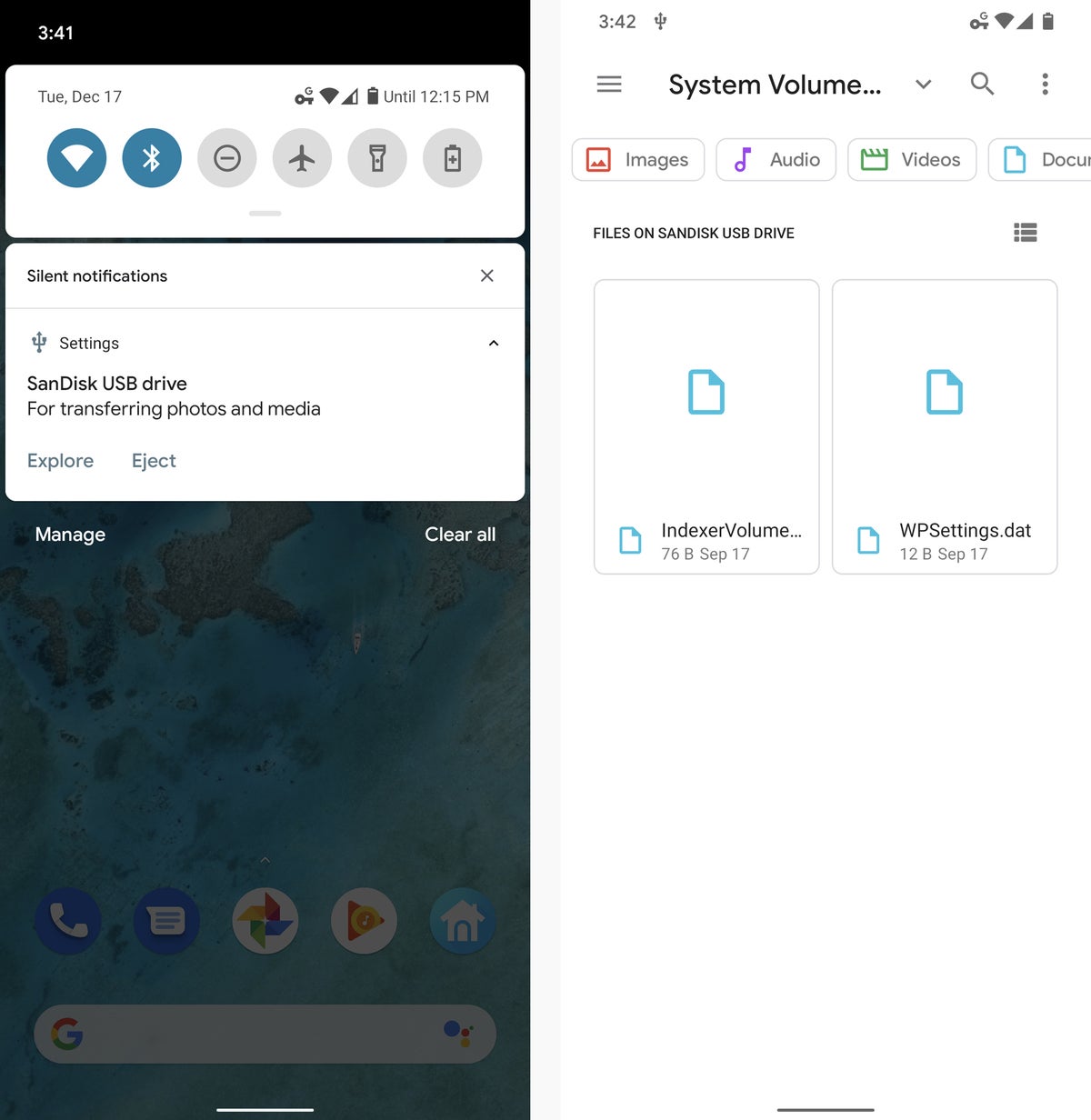
Tap the "Explore" selection within the notification, and that's it: You can now scan and access all the files on your external drive.
 JR Raphael/IDG
 Look for the notification that pops upward when an external drive is connected, and yous'll be browsing the bulldoze's contents in no time.
When you're finished, don't forget to go back to the notification and tap "Eject" before disconnecting the bulldoze.
Transferring files betwixt your phone and computer
In addition to supporting external difficult drives, your Android phone tin act every bit an external hard drive. Just plug your device into any Windows, Mac, or Chrome Os estimator, and you can admission its entire file system and drag and drib files betwixt it and your desktop with ease.
With a Windows or Chrome OS arrangement, it's essentially as simple every bit plug and play. With a Mac, you'll first demand to install a special programme on your computer earlier the connection can be established.
For step-by-step instructions on any of those fronts, click over to my comprehensive Android file transfer guide.
Transferring files wirelessly between devices
Want to transfer files between your Android phone and a computer (or some other Android phone, iPhone, etc.) without the demand for wires? No trouble.
Your most basic option is to embrace a middleman — specifically, a cloud storage service like Google Drive, Dropbox, or Microsoft OneDrive. Just upload the files to a binder inside the corresponding app on your Android telephone, and so find the binder within the same app on the receiving device (or vice versa).
You lot can get more avant-garde than that, though — and make your life significantly easier as a result. If you lot're transferring between ii Android devices in the same physical expanse, Google's ain Files app (which, confusingly, is not the same as the aforementioned Files app that comes preinstalled on many devices) will get the job done with minimal fuss and hassle. Just install the app on both devices, tap the Share tab at its bottom, and and then tap the Send or Receive button to fix the transfer. The app will automatically encrypt any data information technology sends.
If you're using devices on different platforms — and/or devices that aren't in the aforementioned concrete location — a handy tool worth because is a multiplatform app called Join (which also has the ability to encrypt its transfers, though you'll need to look inside the app's settings to activate that pick). Install the app on your Android device and and then install that same app, the Chrome version, or the Windows 10 version on any other device with which y'all want to share files. Y'all can too access the service via a regular website on whatever desktop computer — if, for case, you lot utilize a Mac along with a browser other than Chrome.
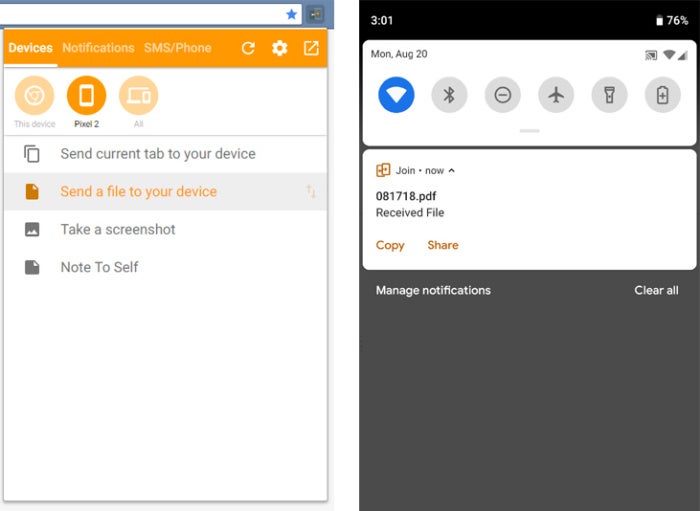
In one case yous've signed into the apps on both ends, you lot're set up to initiate hassle-complimentary file transfers in either direction. On Android, only share a file from any app — a file manager, an paradigm gallery, or any other sort of file-using utility — and select Join as the destination. The file will appear on your desktop inside seconds.
On a computer, meanwhile, sending a file is equally simple every bit opening the Join app or extension, selecting your phone equally the receiving device, and and then dragging the file into the window.
 JR Raphael / IDG
 Drop a file into Join on your desktop (left), and it'll appear on your Android device a 2nd later on (correct).
Join has a agglomeration of other functions — including the ability to send a "Note to cocky"-style notification from a computer to your phone and even to paste text from a calculator straight into your phone's clipboard — just even if you just apply it for wireless file transfers, it's well worth keeping around. The app comes with a free (ad-supported) one-month trial and then requires a one-time $5 buy if you want to keep using information technology.
Syncing your Android phone'due south storage with a computer
Perhaps you like having sure files stored locally on your Android phone, simply you likewise want those files to be backed up and saved on your computer. The all-time of both worlds, right?
Believe it or not, this is actually quite easy to pull off. Just catch an Android app called AutoSync, which is available for use with Google Bulldoze, Microsoft OneDrive, Dropbox, and Box. Information technology'll allow you create pairings between a local folder on your phone and a cloud-based folder — for free with a unmarried folder pair and files smaller than 10MB or for a i-fourth dimension $v payment without any existent restrictions.
Install the advisable computer-side app for whichever service you prefer, make certain it'due south set to sync with your reckoner's difficult bulldoze — and there ya have it: Your Android device's binder is now finer role of your PC.
You can fifty-fifty have the folders stay constantly synced in both directions — and then if y'all add or update a file on the figurer, the same changes volition appear on your phone likewise.
That'south a wrap!
Congratulations: You've officially earned the title of Android file master. (For existent — you can fifty-fifty type it into a document, print information technology out, and tape it to your desk so everyone knows.)
Side by side upward: Make certain you lot sympathize the ins and outs of Android backups. They're ultimately made upward of files, too, after all — and pretty important ones, at that.
This article was originally published in September 2017 and about recently updated in February 2020.
Copyright © 2020 IDG Communications, Inc.

How To Set Up Folders On Android Phone,
Source: https://www.computerworld.com/article/3221287/android-file-management-an-easy-to-follow-guide.html
Posted by: albrechtaccourse.blogspot.com
0 Response to "How To Set Up Folders On Android Phone"
Post a Comment